Our Breeding Program
Squam River American Northern Inuit Dogs is located in the Lakes Region of New Hampshire, more or less in the center of the state. Our dogs are family members who live in our home. We have no plans to ever become a large-scale breeder, but rather will stay small, to focus on the health and development of the Northern Inuit breed.
SRANID is a member of the breeders’ organization Northern Inuits International Unleashed (NIIU) (https://www.northerninuitbreed.com/).
Health Screening
Any potential mating pair must go through full health screenings, including genetic testing with Embark.
The key reason for this testing is to screen for possible genetic health issues. For example, does either dog carry the variant for a condition like degenerative myelopathy (DM), sometimes referred to as canine Lou Gehrig’s disease? If one dog is a carrier, and the other not, then their puppies will never develop the condition, although about half will probably carry it. However, if both breeding candidates are carriers, then they cannot be mated, because at least 25% of the puppies will be likely to end up with DM. No conscientious breeder can take this risk.
Embark also provides a function called “Pair Predictor” that allows breeders to project the genetic outcomes of breeding two dogs who have been tested. This prediction allows us to determine what is known as the “Coefficient of Inbreeding”, or COI, to determine the degree of inbreeding the mating would result in. NIIU breeders aim for a 12% COI or lower, and do not sanction matings that would result in a COI higher than 25%.
For that purpose, NIIU has built an extensive database that goes back as far as possible as is known to the early days of the breed.
To ensure accuracy, NIIU recommends calculating the COI over at least ten generations, which the database allows them to do. Tracking it over only four or five generations does not always accurately reflect true inbreeding levels and might not detect potential emerging health issues.
The objective is to keep COI levels within the safe, sustainable target range.
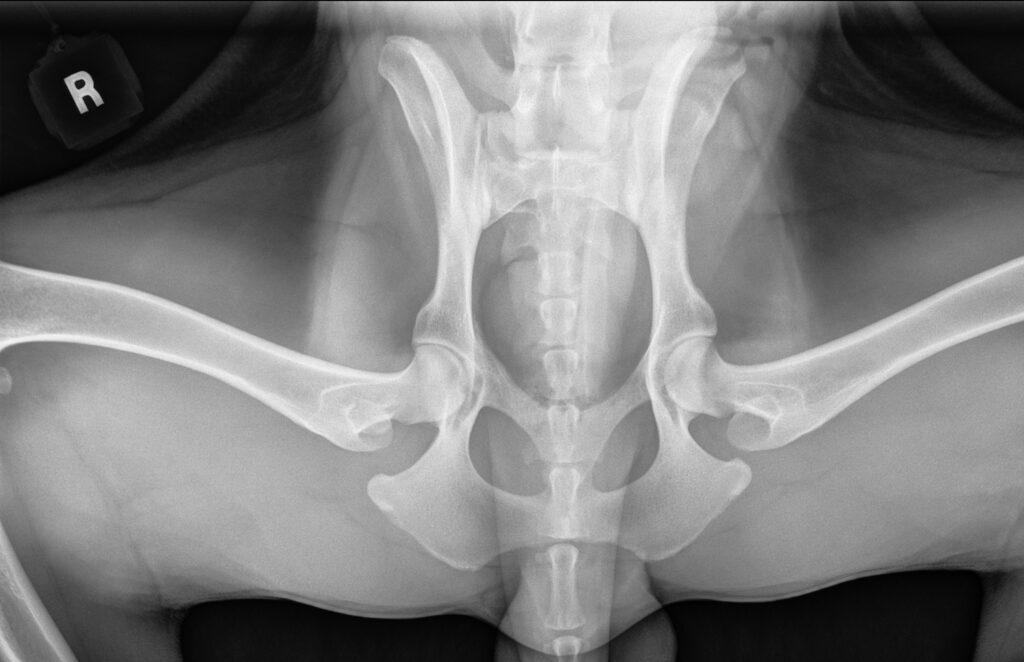
We also test each dog’s hips using the PennHip Screening Tool, or the screening provided by the Orthopedic Foundation for Animals (OFA) (https://ofa.org/). We do this to reduce the risk of breeding dogs likely to develop hip dysplasia. We also screen their elbows through OFA.
We test for potential issues with a dog’s eyes, including glaucoma, as well as for for Oculo-Skeletal Dysplasia 3, again, to rule out pairings that would breed puppies with any of these conditions.
Finally, we test the potential mating pair for canine Brucellosis, a contagious, incurable bacterial disease caused by Brucella canis. It primarily targets the reproductive system—causing infertility, abortions, and swollen testicles—but can also affect the spine and eyes. If an infected dam has puppies, those puppies will die. Therefore, both dogs must be clear of brucellosis for the mating to be approved.
Puppy Raising
As for other features of our breeding practice, puppies stay with us for their first nine weeks. From days 3 to 16, we use Early Neurological Stimulation (ENS: https://goldenmeadowsretrievers.com/early-neurological-stimulation/).
We also follow what is known as the “Puppy Culture” method (https://shoppuppyculture.com/pages/about-puppy-culture), which ensures developmental and socialization best practices for the puppies during their time with us.
Beginning at three weeks, we start to introduce puppies to new sounds and a wide array of other experiences, to help them socialize and become comfortable when confronted with new things.
At 7 weeks, we also have each puppy temperament tested. Doing so gives us an approximate behavioral portrait that helps with placement and with identifying areas to focus on in training and care.
Each of our puppies comes with a four-generation pedigree, pictures from their infancy through to the point of their adoption, the results from their temperament test, full health clearance from our vet, a health certificate confirming that they have been cleared by our vet to leave the state, documentation of their having received all requisite age-related medical procedures, a puppy binder with additional information and resources for ongoing care, training, and socialization, a week’s worth of food and treats, and a few of their favorite toys. We also provide articles related to ongoing care and training, as well as a list of additional resources. We expect to stay engaged as ongoing resources for our puppy parents.